Budva (black: Budva) is a city in Montenegro, the administrative center of the Budva municipality. It is located in the central part of the Adriatic coast of the country. Budva, founded about 2,500 years ago, is one of the oldest settlements on the shores of the Adriatic Sea. Together with its surroundings, it forms the Budva Riviera - the largest tourist center in Montenegro, famous for its sandy beaches, nightlife and beautiful examples of Mediterranean architecture.
Geography
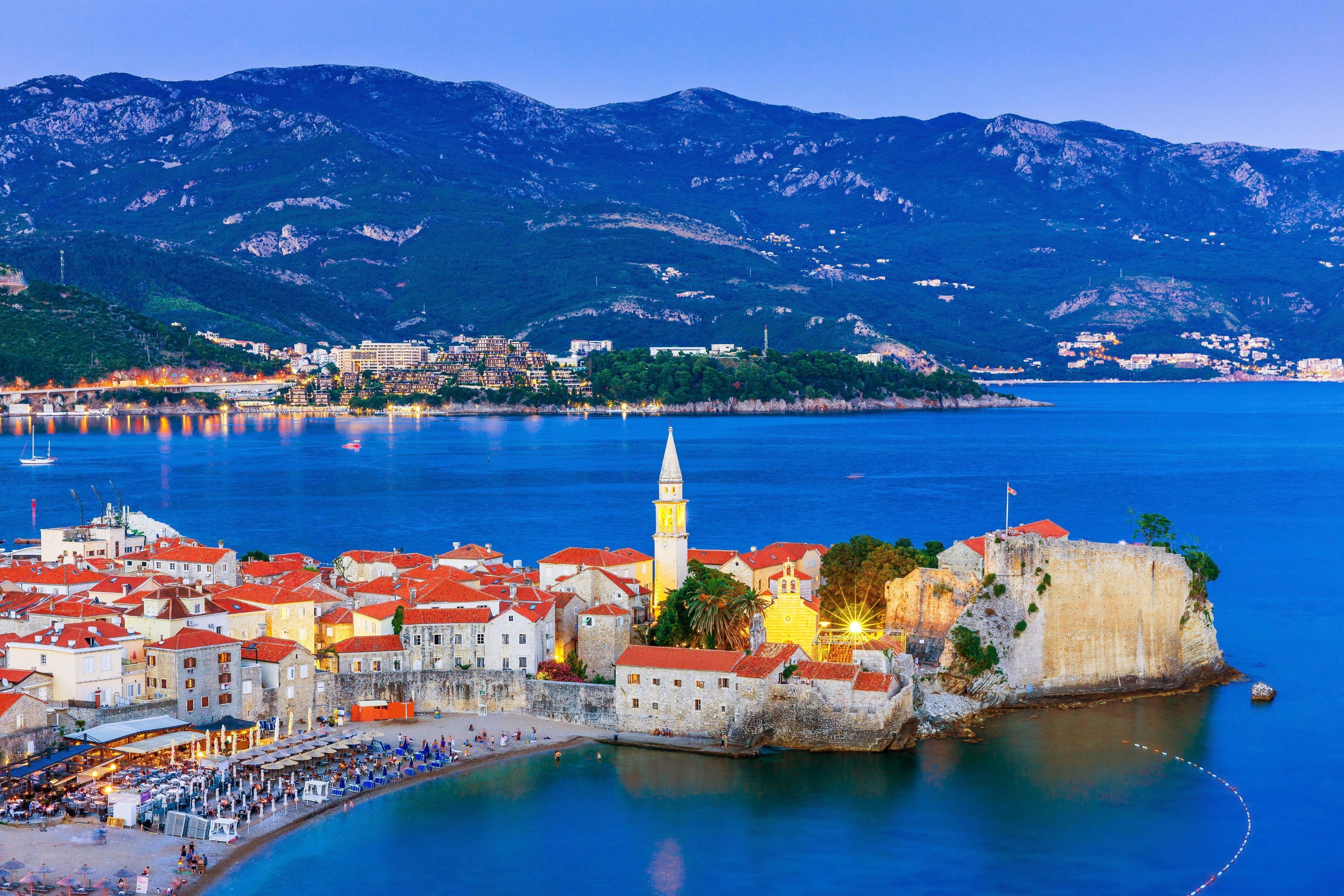
Budva District occupies an area of 122 km². The coastal strip is quickly replaced by a mountainous landscape. The mountains, consisting of sedimentary rocks, are covered with sparse thorny shrubs. The new town is located along the shores of a small bay. In the north, the bay ends with a cape on which the old fortress is located. Not far from Budva, in line of sight, is the island of St. Nicholas, one of the few islands on the coast of Montenegro. The so-called Adriatic Tract (Adriatic Way) passes through the city, a highway that connects numerous settlements in Greece, Albania, Montenegro, Bosnia, and Croatia.
History
The exact time of Budva's origin is unknown. The legend calls the founder of the city Cadmus, a Phoenician prince and ruler of the Greek city of Thebes, who allegedly renounced power in Thebes in favor of his grandson and, together with his wife Harmony, went to the possessions of the Illyrians. The Phoenician origin of Budva is also evidenced by its location - the Phoenicians often founded their colonies on small islands near the coast. After all, the very name of the city may come from the Phoenician דתְּ - "home". The attempt to derive it from the Greek βους — "ox" is most likely a later etymological legend. Stephen of Byzantium did not consider the name of the city to be Greek and generally associated it with the name of the Egyptian city of Buto. The first mention of Budva as a settlement of Butou dates back to the 5th century BC. In the 20th century, during the construction of one of the hotels, the remains of ancient Greek and ancient Roman necropolises were discovered, the oldest fragments of which probably date back to the middle of the 1st millennium BC. Budva was part of the Roman state, and later the Byzantine Empire. With the beginning of the resettlement of the Slavs to the Balkans, the name Stari Grad was for a certain time. In 841, it was burned by the Saracens, but quickly rebuilt. During the Middle Ages, Budva turned into a self-governing urban community, had its own charter and head - the rector, who was elected from among the wealthiest merchant families. At the same time, the lords of neighboring Dukli and Zeta retained supreme power over the city. In 1385, the governor of Budva, Mykola Zaharia, declared himself an independent ruler, but in three years it was regained by Prince Juraj II Balšich. Since 1420, the city has been under the rule of Venice, since 1797 - Austria (with a short "break" for French rule). In 1914, Budva was occupied by Montenegrin troops, but the Austrians soon regained control of the city. After the First World War, Budva was part of Yugoslavia, during the Second World War it was occupied by the Italians. With the final disintegration of Yugoslavia, it was left to Montenegro. Today, Budva is a modern city consisting of the Old and New parts. The old town is surrounded by high fortress walls, built in the 15th century before the Turkish invasion. The walls are fortified with several towers and the Castel fortress. Several gates lead to the Old City, which in ancient times were well guarded and closed at night. Today, these gates are wide open. Behind the fortress walls are narrow curved streets and medieval squares, buildings built of hewn stone. Above the city rises the church of St. Ivan with a majestic bell tower - a building of the 7th century. Cafes, restaurants and shops can be found at every turn in the Old and New Towns.